

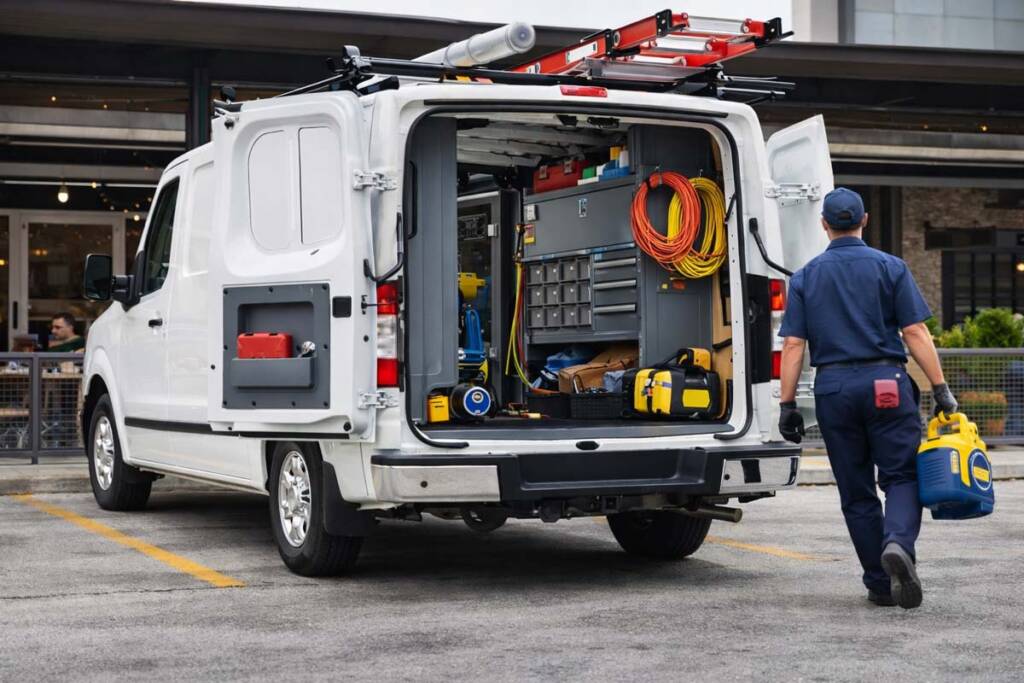
Running a successful HVAC business requires more than skilled technicians and consistent customer demand; it requires a fleet strategy that keeps those technicians on the road, productive, and fully equipped to handle every job. The HVAC industry today is being defined by consolidation, PE influence, higher costs, and increasing pressure to deliver faster service. As these forces reshape the HVAC business landscape, fleet management plays a central role in maintaining efficiency and supporting growth.
Your vehicles do more than transport technicians and equipment; they are revenue-generating assets.
Every job completed, customer served, or branch expansion relies on having the right vans and trucks ready at the right time. That’s why the most successful HVAC companies are shifting toward smarter fleet management practices, leveraging data, flexible financing, standardized upfits, and real-time visibility to run leaner, faster, and more profitably.
This comprehensive guide breaks down what growing HVAC fleets need to know, from eliminating hidden costs to improving uptime. Whether you’re a self-managed regional business or a PE-backed multi-brand organization, this guide will help you build a fleet strategy that increases technician uptime, strengthens EBITDA, and equips your operations for long-term success.
Why an Optimized HVAC Fleet Matters More Than Ever
The HVAC industry is changing quickly. Consolidation is accelerating, competition is intensifying, and customer expectations for speed and reliability are higher than ever. PE-backed platforms are expanding through acquisitions, and even independently owned HVAC companies face mounting pressure to operate more efficiently.
Because technicians drive revenue, your fleet sits at the center of your performance. Every operational decision — which vehicles to acquire, how to structure financing, how to manage maintenance, how to standardize upfits — directly affects your profitability and your ability to serve customers.
HVAC fleets also face unique challenges compared to other home services segments:
- Complex, heavy upfits that require careful engineering
- Seasonal spikes that amplify bottlenecks in procurement
- High utilization that accelerates wear and tear
- Large equipment loads that require reliable specs and weight distribution
When fleet decisions aren’t aligned with business strategy, HVAC operators experience cascading problems including long lead times, downtime during peak season, capital strain, inconsistent technician performance, and multi-branch inefficiency.
A well-optimized fleet, however, transforms these challenges into competitive advantages. With standardized vehicles, predictable operating costs, faster access to inventory, and centralized visibility, HVAC organizations can build a scalable operational foundation that supports growth, profitability, and superior customer experience.
The Hidden Costs Holding HVAC Fleets Back
Many HVAC businesses don’t realize how much inefficiency is hiding within their fleet operations. On the surface, vehicles appear to be fixed assets that simply get technicians from point A to point B. But underneath that are substantial financial and operational risks, especially when fleets are decentralized or managed manually.
Below are the most common hidden costs that are draining HVAC profitability.
1. Long Vehicle Acquisition & Upfit Delays
HVAC companies often struggle with slow procurement cycles, a challenge that becomes especially painful during busy seasons. Long factory order lead times, inconsistent upfit vendors, and limited OEM inventory availability can turn vehicle acquisition into a multi-month roadblock.
And these delays have real consequences:
- Technicians cannot be deployed
- Branch openings stall
- Rental costs pile up
- Upfit inconsistency leads to operational inefficiency
Many HVAC companies, especially PE-backed organizations, also experience delays because each acquired brand has its own historical suppliers, upfitters, or procurement habits. Without centralization, the entire process slows down.
Sophisticated HVAC companies now rely on diversified sourcing models including ready-to-deploy inventory, national dealer networks, and standardized upfit programs to avoid bottlenecks and keep technicians on the road.
2. Lack of Visibility Across the Fleet
It’s still common for HVAC companies to manage their fleet using spreadsheets or manual reporting, especially among businesses that manage their own vehicle fleets.
Without real-time visibility into:
- Maintenance activity
- Vehicle condition and service history
- Fuel spend
- Cost per mile
- Vehicle location
- Replacement cycles
decision-making becomes more reactive rather than strategic.
For PE-owned HVAC groups, the visibility challenge is even greater: decentralized branches often maintain separate tracking systems, vendors, and upfit processes. When reporting is fragmented, the ability to manage cost, performance, or EBITDA impact becomes limited.
Advanced fleet platforms give HVAC leaders centralized, real-time oversight. It’s a critical shift that allows businesses to forecast needs, identify problems early, and optimize fleet efficiency across multiple locations.
3. Cash Flow Constraints & Financing Limitations
Buying vehicles outright may feel like the simplest solution, but it is also the most capital-intensive. For HVAC companies, especially those expanding, hiring technicians, or acquiring new brands, vehicle purchases can constrain strategic growth.
Capital that could be used for:
- Opening new branches
- Hiring technicians
- Pursuing acquisitions
- Reducing debt
- Investing in equipment
instead becomes tied up in depreciating assets.
Self-managed HVAC fleet operators often struggle with traditional financing requirements, while PE-backed platforms are focused on EBITDA improvement and balance sheet optimization. Both may benefit from shifting away from ownership models and toward flexible leasing strategies that preserve capital and support long-term growth.
4. Operational Downtime
Downtime is the silent killer of profitability. Every hour a technician is unable to complete a service call affects:
- Revenue per tech
- Customer satisfaction
- Scheduling backlog
- Emergency response capability
- Brand reputation
Downtime isn’t just caused by breakdowns though. Inconsistent upfits, lack of maintenance planning, poor vehicle condition, or delayed acquisitions all play a role.
Read More: How HVAC Companies Reduce Technician Downtime and Increase Profitability
How Modern HVAC Fleets Reduce Downtime and Boost Profitability
To stay competitive, HVAC leaders are adopting more advanced, data-driven strategies that directly target operational bottlenecks that slow growth. These strategies focus on real-time fleet visibility, faster access to vehicles, and standardizing equipment to create a more predictable, scalable operation.
Real-Time Fleet Insights
Modern fleet management platforms combine vehicle telematics, maintenance automation, and real-time reporting to give HVAC operators clarity across their entire fleet. This type of visibility is essential for both multi-location, PE-backed enterprises, and local self-managed operators.
Key insights include:
- Maintenance forecasting — prevent unplanned breakdowns
- Cost per mile monitoring — identify inefficiencies
- Idle time tracking — control fuel and emissions
- Vehicle availability insights — right-size the fleet
- Lifecycle analysis — plan replacements strategically
This data eliminates manual reporting and equips operators to make smarter decisions that support technician readiness and reduce total cost of ownership.
Faster Vehicle Access
Speed of acquisition is one of the most important levers HVAC organizations can control. During peak season, every delay is amplified.
The most efficient fleets use multiple acquisition channels:
- Ready-to-deploy inventory for immediate needs
- Bailment pools for faster upfit turnaround
- Factory-direct orders for long-term planning
- National dealer networks to fill unexpected gaps
An HVAC company that secures vehicles quickly can onboard technicians faster, open new locations more efficiently, and maintain service capacity even during supply chain disruptions.
Standardized Upfits Across All Technicians
Consistency is one of the highest-impact improvements an HVAC company can make.
A standardized upfit strategy ensures that every technician uses:
- The same shelving
- The same tool organization
- The same storage layout
- The same safety equipment
- The same vehicle type (where possible)
This leads to measurable operational benefits:
- Training becomes faster and more scalable
- Technicians complete more jobs per day
- Inventory is easier to manage and restock
- Vehicle weight and balance remain consistent
- Downtime decreases due to fewer equipment issues
PE-backed HVAC businesses especially benefit from standardization because it creates operational alignment across all acquired brands.
HVAC Fleet Leasing: A Smarter Alternative to Buying
Across the HVAC industry, operators are moving away from purchasing vehicles outright and toward flexible leasing structures. This shift is driven by the need for improved cash flow, standardized vehicles, predictable budgeting, and faster access to ready-to-work vans and trucks.
Read More: HVAC Fleet Leasing: Is Leasing or Buying the Better Strategy for HVAC Growth?
Why Leasing Benefits HVAC Operators
Switching to leasing provides several financial and operational advantages:
- Lower monthly payments that improve cash flow
- No large upfront CapEx, preserving capital for growth
- Predictable lifecycle planning that prevents costly surprises
- Faster access to vehicles, especially through national sourcing
- Consistent specs across branches for scalable growth
- EBITDA-friendly accounting for PE-backed companies
Hybrid capital leases are particularly valuable for private equity–owned HVAC groups because they align with valuation models while preserving operational flexibility.
Self-managed regional HVAC companies benefit as well. Leasing gives them access to cost-effective financing that is often unavailable through traditional channels.
Fleet Technology Built for HVAC Performance
Given the heavy usage HVAC vehicles endure, technology plays a critical role in reducing downtime and optimizing operations.
HVAC fleets can utilize telematics and connected vehicle data for:
- Breakdown prevention with maintenance scheduling automation
- Real-time engine diagnostics that prevent expensive repairs
- Automated maintenance approvals to control costs
- Asset tracking for multi-branch organizations
These tools give fleet managers an unprecedented level of operational control, transforming the fleet into a performance engine rather than a cost center.
How Merchants Supports HVAC Operators
HVAC organizations choose Merchants because we align fleet strategy with financial impact, operational performance, and scalable growth. Our approach is built on flexibility, speed, and deep industry expertise.
Read More: Turnpoint is ‘Bringing It All Together”
Flexible Lease & Finance Strategies
Merchants designs lease structures tailored for both PE-backed and independently owned HVAC companies. Options include:
- Hybrid capital leases
- Short- and long-term fleet programs
- OpEx-friendly structures
- Minimal upfront cost solutions
These strategies support EBITDA optimization and allow HVAC companies to preserve capital for growth, acquisitions, and technician hiring.
Rapid Vehicle Access Through ReadyFleet
HVAC companies cannot afford long acquisition delays, especially during peak season. Merchants ReadyFleet program provides immediate access to work-ready vans and trucks, eliminating long lead times and keeping technicians fully deployed.
National Upfit Partner Network
Our ASE-certified engineering teams build standardized HVAC-spec upfit packages designed for technician productivity and long-term durability. A national network of upfit partners ensures consistency, speed, and quality across all branches.
Real-Time Fleet Visibility
Merchants’ TotalView platform gives HVAC operators real-time insights into maintenance, lifecycle costs, and fleet planning. Automated reporting simplifies multi-location oversight and supports data-driven decisions.
High-Touch Client Support
HVAC organizations, especially multi-brand portfolios, rely on Merchants personalized, high-touch account structure for continuity, strategic guidance, and hands-on partnership. Your dedicated team becomes an extension of your operations, ensuring that every branch stays aligned and productive.
Final Thoughts
The most successful HVAC companies are those that treat fleet management as a strategic growth lever, not just an operational necessity. By improving visibility, standardizing upfits, restructuring fleet financing, and securing faster access to vehicles, HVAC operators drastically reduce downtime and equip their technicians to perform their jobs at the highest level.
Whether you’re onboarding new technicians, expanding into new markets, or integrating newly acquired brands, an optimized fleet strategy enables your business to scale with confidence, control, and speed.